When Everyone Has the Same Algorithms, Creative Matters More
AI made ad production abundant. The advantage is learning which ideas deserve more spend—and acting before the moment passes.
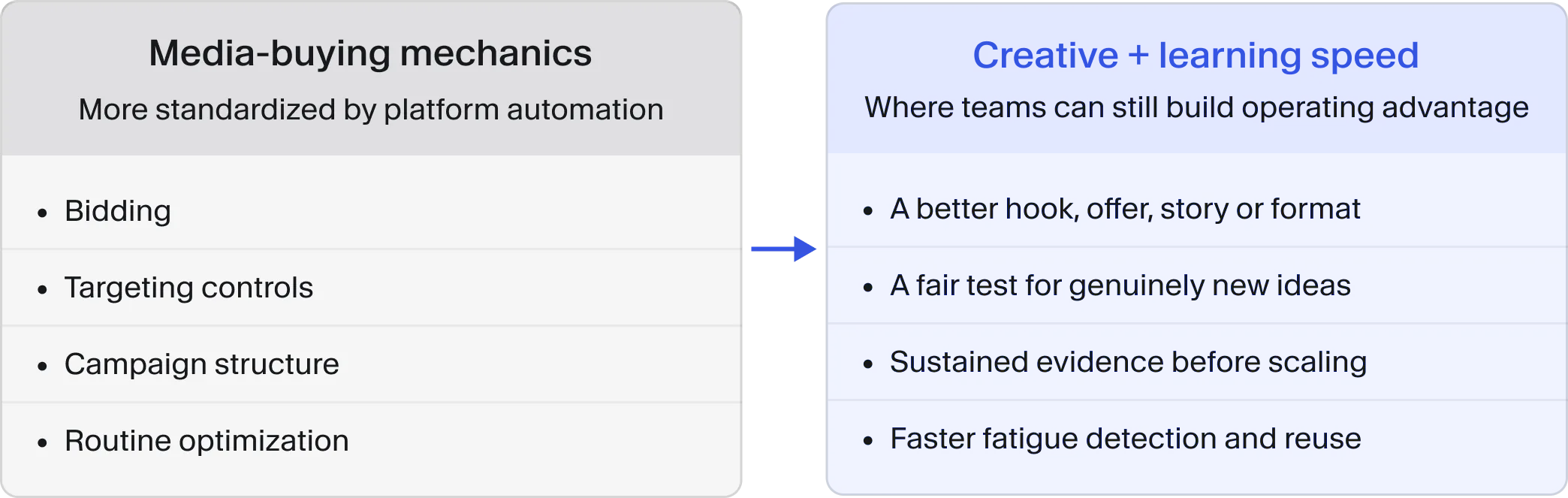
For years, a strong media buyer could create an edge through the way an account was run. Bidding, targeting, campaign structure, and day-to-day optimization all left room for meaningful operator advantage.
Platforms have automated more of that work. The best operators still matter, but the mechanical gap between an excellent team and the default platform tooling is narrower than it used to be.
At the same time, AI has made ad production much cheaper. Most teams can now produce more variants than they can test properly. That changes the constraint.
The useful advantage is not how many ads you can make. It is how quickly you can learn which idea deserves more spend, whether the result is real, and when the winner is starting to wear out.
Where the advantage moves as platform mechanics automate
The bottleneck shifts from producing more ads to learning faster from the right ideas.
On Meta, creative helps determine who the platform finds
People do not usually open Instagram or Facebook with a precise purchase in mind. The ad creates the interruption, the interest, and often the first signal of intent.
Change the hook, offer, story, or format and a different group of people may respond. That is why creative is not separate from targeting on Meta. The creative itself changes the audience response the system can learn from.
Once creative has that much influence on delivery, testing cannot be treated as a production checklist. It is part of the media-buying system.
More ads do not automatically create more learning
AI has made it inexpensive to generate another set of ads. When every brand can produce dozens of variants, volume alone stops being a durable advantage.
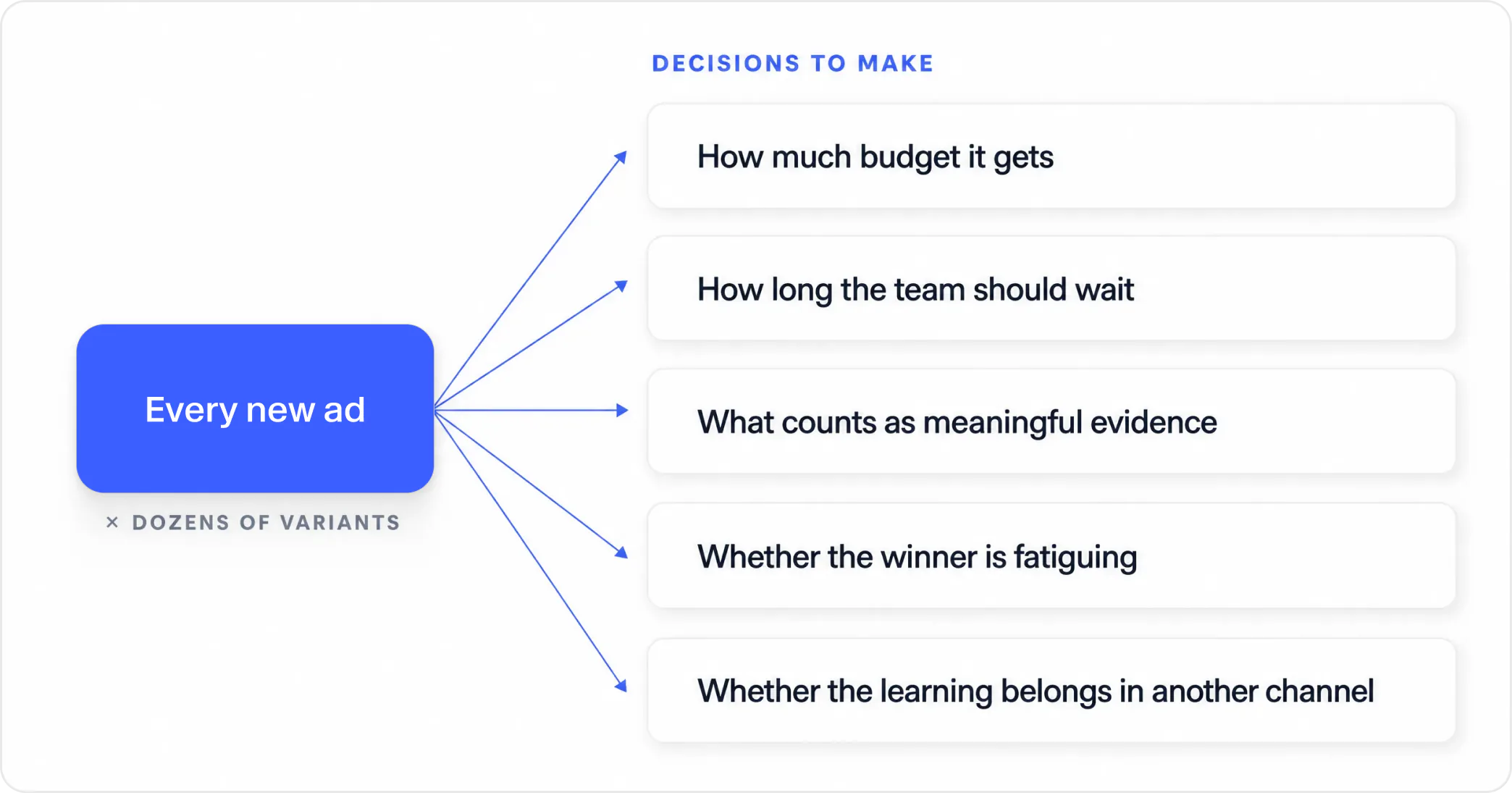
A larger asset library can actually make the operating problem harder. Every new ad creates decisions about how much budget it gets, how long the team should wait, what counts as meaningful evidence, whether the winner is fatiguing, and whether the learning belongs in another channel.
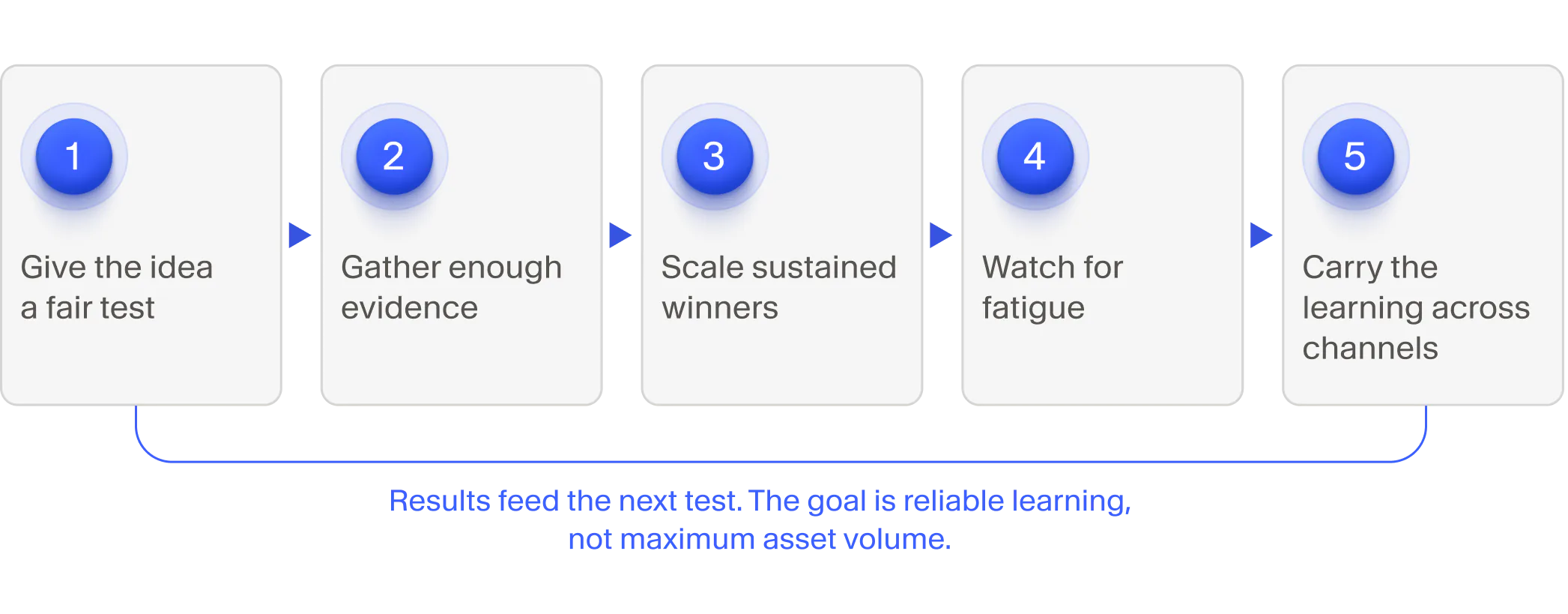
The better system is the one that gives genuinely different ideas a fair chance, waits for enough evidence to trust the result, and turns that evidence into the next budget decision.
Give new creative a fair test
Put a new ad directly into a campaign with established winners and it may receive very little delivery. If that happens, the team cannot tell whether the idea failed or simply never got a meaningful test.
New creative needs a controlled place to prove itself, with enough budget and time to generate useful evidence. MAI's documented operating model supports controlled exploration budget for promising creatives, then increases or reduces investment as sustained account-level evidence develops.
One strong Tuesday should not define a winner. The system should be looking for performance that holds up long enough to justify the next move, while continuing to watch for fatigue after the creative scales.
A creative system should optimize the learning loop
More production only helps when each new idea gets enough evidence to change the next decision.
Do not let a winning idea stay trapped in one platform
A strong creative result on Meta is useful evidence even if the next test happens somewhere else. A video that earns sustained attention and conversion on Meta may be worth trying in YouTube or Demand Gen. The transfer is not automatic proof that it will work there, but it is a better starting point than treating every channel as a separate creative universe.
MAI can compare creative performance across connected channels and surface cross-channel learning opportunities. Automated cross-platform deployment should still be evaluated based on the workflow and permissions in use; the important point is that the learning does not have to stop at the platform boundary.
The creative idea still belongs to the team
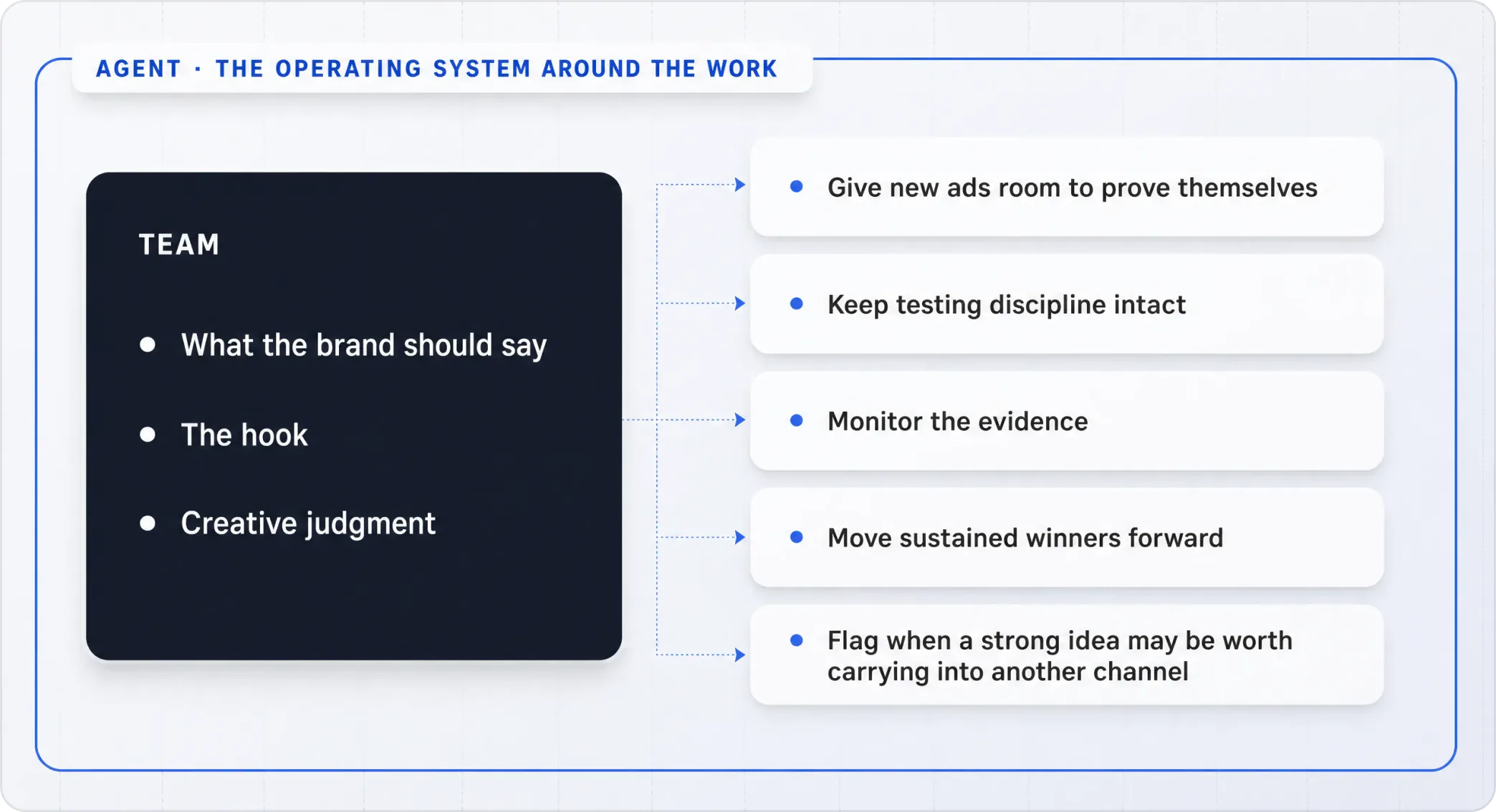
MAI is not a creative strategy engine. It does not decide what the brand should say, invent the hook, or replace the people responsible for creative judgment.
Its role is closer to the operating system around the work: give new ads room to prove themselves, keep testing discipline intact, monitor the evidence, move sustained winners forward, and flag when a strong idea may be worth carrying into another channel.
That division matters because the scarce part of creative is still judgment. The agent can make the testing loop more continuous so the team has more time to decide what to make next.
The advantage is speed to learning
When the team makes a genuinely better ad, how long does it take for spend to reflect that?
If the answer is weeks, the organization is learning slowly. Faster-moving brands do not need to make a better ad every time. They need to identify credible winners sooner, put more budget behind them while the opportunity still matters, and replace them before fatigue becomes expensive.
That is where AI media buying can help: shorter distance between a good idea, credible evidence, and the next budget decision—without asking the software to make the creative judgment itself.
This operating model also connects to two adjacent problems: how AI agents replace fixed rules with context-aware decisions, and how creative fatigue becomes a growth constraint for health and nutrition brands.