How to Choose a Performance Marketing Measurement System (2026)
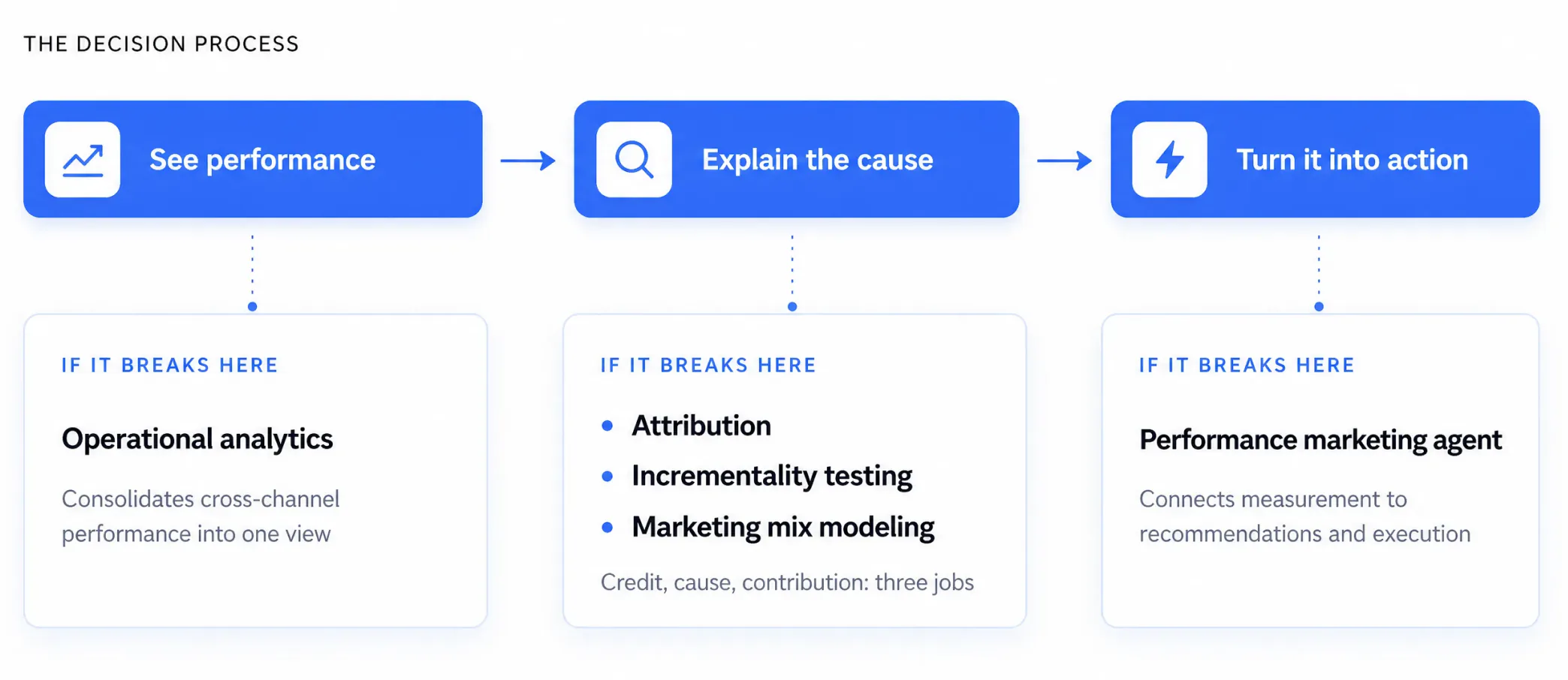
Quick answer: There is no single best performance marketing measurement platform. The market includes five categories solving different jobs: operational analytics, attribution, incrementality testing, marketing mix modeling, and performance marketing agents.
Disclosure: MAI, our product, belongs to the performance marketing agent category described below. The selection framework applies regardless of which vendors you evaluate.
Start with the bottleneck
| Where the process breaks | Start here |
|---|---|
| Cannot see performance clearly | Operational analytics |
| Can see performance, but cannot explain it | Attribution, incrementality testing, or marketing mix modeling |
| Trust the measurement, but nothing changes | Performance marketing agent + execution process |
Choose the category that addresses the point where your current decision process stops. This is a starting point, not a maturity ladder; sophisticated teams may use several categories because each answers a different question.
The market is easier to understand as three bottlenecks
Performance marketing teams have plenty of data. Dashboards update quickly, reports are easy to build, and every platform promises better visibility. Yet campaigns still run after creative fatigues, budget changes still arrive late, and teams still spend too much time reconciling reports.
Before comparing feature pages, identify which problem is actually slowing the team down.
1. You cannot see performance clearly
Google reports one number, Meta reports another, and Shopify reports revenue that matches neither. The team spends Monday mornings exporting spreadsheets and reconciling definitions instead of improving campaigns.
Operational analytics platforms are built for this problem. They consolidate cross-channel performance into a usable reporting layer. If the team cannot agree on what happened, start here.
2. You can see performance but cannot explain it
ROAS declines. Is the cause creative fatigue, tracking, seasonality, or a competitor outbidding you? Each explanation calls for a different response, and a dashboard cannot determine which one applies.
This bottleneck contains three different measurement jobs:
- Attribution estimates which touchpoints deserve credit.
- Incrementality testing measures whether marketing caused additional revenue.
- Marketing mix modeling estimates channel contribution over time and supports budget-allocation decisions.
These approaches are complementary, not interchangeable. Mature organizations often use all three because credit, cause, and contribution answer different questions.
3. You trust the measurement but nothing changes
This is where sophisticated organizations often get stuck. Three dashboards give different answers, the response is another report, the report earns another meeting, and weeks later the original problem is still in the account.
At that point, reporting may no longer be the constraint. The issue is getting from a trusted signal to a campaign decision while the opportunity still matters. Every meeting, approval, and handoff adds time between recognizing a problem and changing the account.
Performance marketing agents are designed for this part of the system: connecting measurement to recommendations and execution with an appropriate approval process.
Three questions to ask every vendor
Once the bottleneck is clear, take three questions into every vendor conversation:
- 1. Can I trust the underlying data?
- 2. Does the system measure correlation, credit, contribution, or causation?
- 3. Once it finds something, how quickly can the team act on it?
Integrations, dashboards, and connectors still matter. These questions are more useful because they reveal what the product is built to do, what standard of evidence it provides, and where responsibility returns to the team.
The five measurement categories, compared
| Category | Question it answers | Standard of evidence | Who acts on the output |
|---|---|---|---|
| Operational analytics | What is happening across my channels? | Descriptive | Your team |
| Attribution | Which touchpoints deserve credit? | Modeled estimate | Your team |
| Incrementality testing | Did the spend cause additional revenue? | Experimental and causal | Your team |
| Marketing mix modeling | How should budget be allocated? | Modeled, ideally calibrated with experiments | Your team |
| Performance marketing agent | What should change, and who changes it? | Combines the approaches above | The agent, with your approval |
Two things are worth noticing. First, the standard of evidence changes with the question. A dashboard can describe what is happening. Attribution estimates credit. An incrementality experiment is designed to answer whether spend caused additional revenue.
Second, in four of the five categories, the team still acts on the output. That is not a weakness. It is a capacity and operating-model question the buyer should answer before purchasing.
Most disappointing purchases are the right product bought for the wrong problem.
A practical selection framework
Use this sequence to turn the comparison into a shortlist:
- Name the failed decision. Pick a recent situation in which the team saw a problem too late, could not explain it, or could not act in time.
- Identify the required answer. Decide whether the system must report what happened, allocate credit, establish causation, estimate contribution, or recommend and execute a change.
- Set the evidence standard. Match the confidence required to the cost and reversibility of the decision.
- Assign the final action. Be explicit about whether an analyst, channel owner, agency, or agent will implement the output.
- Evaluate fit before feature depth. A long feature list cannot compensate for choosing the wrong product category.
Where MAI fits
MAI is a performance marketing agent, not an operational analytics platform. It combines measurement and execution, validates the evidence behind recommendations, proposes campaign changes, and prepares them for approval.
Organizations that primarily need attribution reporting or consolidated dashboards should evaluate platforms built for those jobs. Organizations whose measurement is credible but whose bottleneck is execution are solving a different problem.
MAI is relevant when the gap is between insight and campaign action, not simply whenever a team wants better reporting.
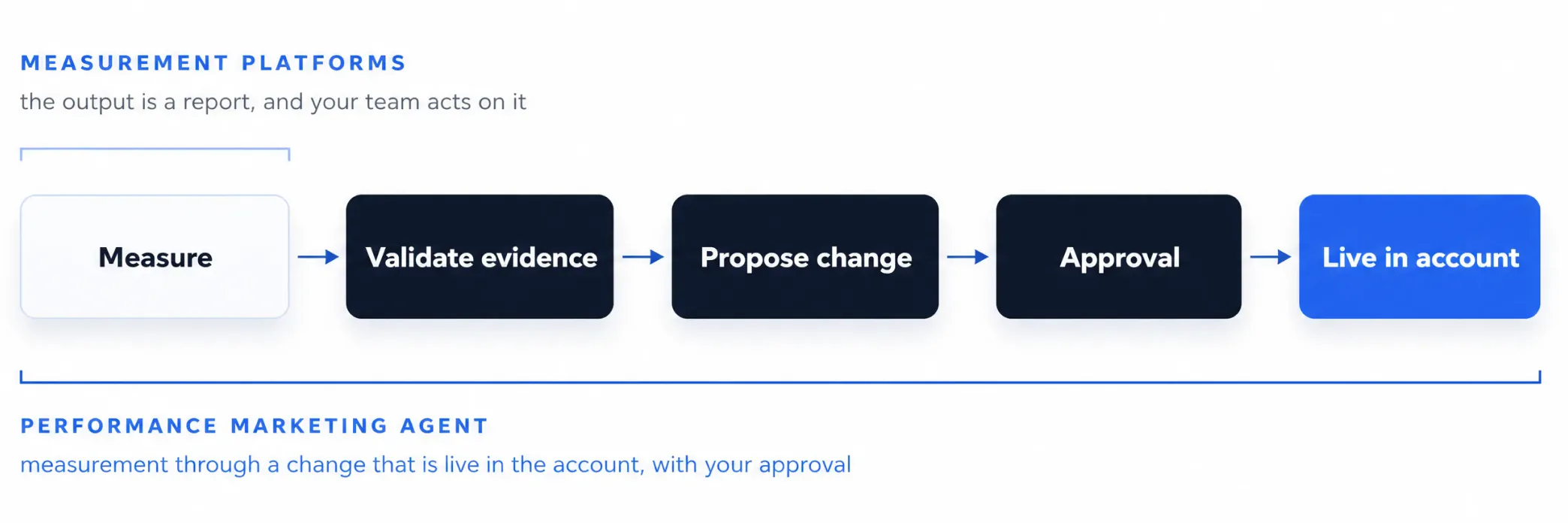
A shorter path from measurement to action
Reporting tells you what happened. Measurement helps explain why. A decision system determines what to do next.
Operational analytics, attribution, incrementality testing, and marketing mix modeling still answer important questions. The practical advantage comes from reducing the distance between recognizing a problem, reaching a sound decision, and changing the campaign.
The best measurement system is the one that fixes the part of your decision process that currently breaks.