Something Changed in Your Ad Account. Now What?
A practical investigation framework for deciding whether to watch, adjust, escalate, or fix something outside the ad platform.
Yesterday the account looked fine. This morning, CPA is up 30%.
That number is enough to get your attention. It is not enough to tell you what to do. Spend may have moved into a weaker campaign. Conversion volume may simply be light. A landing page may be failing. A promotion may have ended. Or nothing meaningful may have changed at all.
The useful work starts after the alert: deciding whether the movement is real, finding where it began, checking what changed around it, and choosing a response that matches the evidence.
Treat the alert as the start of an investigation
Alerts and dashboards are good at showing that a metric moved. A media buyer still has to answer three questions before touching the account:
- Is the movement meaningful?
- Where is it concentrated?
- What else changed at roughly the same time?
The order matters. If you begin by editing bids or budgets, you risk turning a short-lived fluctuation into an account change that now needs its own explanation.
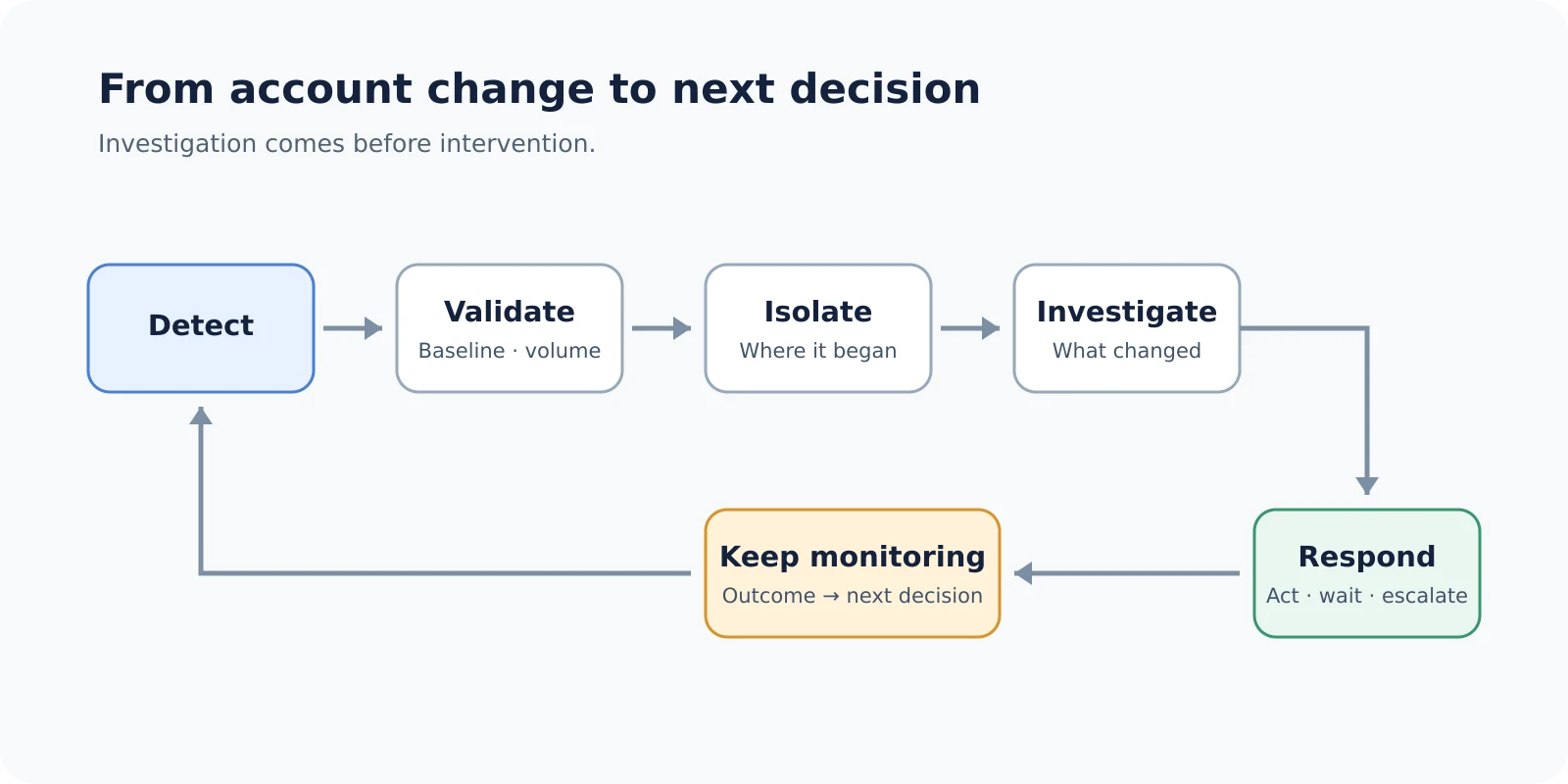
First, decide whether the movement deserves attention
Paid-media results move from one day to the next. Auction pressure changes. Conversion timing shifts. A few missing purchases can make a small campaign look dramatically worse.
Start with the comparison window. A 30% day-over-day CPA increase may look ordinary against the previous four Tuesdays, or serious against a stable eight-week baseline. The right baseline depends on conversion volume, seasonality, weekday effects, recent promotions, and how quickly the account normally settles.
Then check scale. Five conversions do not carry the same weight as five hundred. When volume is thin, the sensible next step may be to keep watching and define what would trigger another review.
Finally, compare the movement with the target that governs the campaign. An unusual result can still sit inside the approved efficiency range. A smaller change outside the target may deserve attention sooner.
Isolate where the change began
Once the movement looks meaningful, break the top-line metric apart. Start wide, then narrow:
- Account, platform, or geography
- Campaign and ad group
- Audience, query, placement, or device
- Product, SKU, or creative
- Landing page and funnel step
Suppose account CPA is up while CPC is stable. If the change is concentrated in one landing page, cutting bids across every campaign would address the wrong part of the system. If conversion rate is stable but spend moved toward a lower-efficiency campaign, the investigation stays closer to budget allocation.
Averages can hide both situations. The account-level symptom is only the starting point.
Investigate the surrounding changes
Now look for events that line up with the performance movement. The goal is to narrow the plausible explanations without pretending the evidence is conclusive.
| Area | Clue | Investigate first |
|---|---|---|
| Media mix | Spend shifted between campaigns | Budget changes, eligibility, and pacing |
| Auctions | CPC or impression share moved | Competition, bids, and query mix |
| Creative or audience | CTR, frequency, or response changed | Asset delivery, fatigue, and audience saturation |
| Landing page or funnel | CPC is stable but conversion rate fell | Page health, speed, and funnel behavior |
| Measurement | Conversion volume changed abruptly | Tags, attribution settings, and data freshness |
| Business context | Performance changed around an operational event | Promotion, inventory, pricing, or demand |
The account history matters here. A bid change made yesterday, a product going out of stock, and a conversion-tag edit should not appear as unrelated facts in separate tools. They belong in the same investigation because each could change how the current result should be interpreted.
Sometimes the evidence will point to one likely cause. More often, it will eliminate several bad explanations and leave two or three plausible ones. That can still be enough to make a good next decision.
Match the response to confidence and consequence
The evidence should determine how much intervention is justified.
Use two inputs:
Confidence: How strong and consistent is the evidence about what changed?
Consequence: How much money, learning, customer demand, or business exposure is affected if you are wrong or wait too long?
| Confidence | Consequence | Least-regret response |
|---|---|---|
| Low | Low | Watch and define the next review trigger |
| Low | High | Protect exposure and escalate for review |
| High | Low | Make a small, reversible adjustment |
| High | High | Act within approved controls; involve the marketer when the decision is consequential |
This is why reversible changes are useful. A contained bid adjustment, a budget move within an approved pool, or pausing a clearly broken destination can limit damage while the evidence develops. A major allocation change, a new target, or a decision with cross-channel implications deserves stronger evidence and often human review.
If the likely cause sits outside the ad account, route it to the right owner. A tracking failure needs measurement or engineering support. A broken product page needs the site team. An inventory issue may require merchandising input. Changing campaigns will not repair those problems.
Keep monitoring after the decision
Every intervention needs a follow-up.
After a change, define what you expect to see and when you will look again. Did conversion rate recover? Did spend return to the intended campaign mix? Did the weak search term stop consuming budget? Did the account stabilize without intervention?
The same rule applies when you wait. “No action” should still include a follow-up condition: another hour of data, a minimum conversion count, the next attribution refresh, or a threshold that would justify escalation.
Without a defined review point, alerts and isolated account changes accumulate. A follow-up turns each decision into evidence for the next one.
What a useful incident record contains
A short decision record makes future investigations faster. It should capture:
- What moved, over which comparison window
- Where the movement was concentrated
- Relevant account, site, tracking, and business changes
- The evidence behind the decision
- What was changed, proposed, escalated, or deliberately left alone
- The expected outcome and review point
A broader ad account audit can use the same incident history to distinguish isolated events from structural issues and recurring opportunities.
This is more useful than an alert feed. It shows whether the team investigated the right layer, whether the response matched the evidence, and what eventually happened.
How MAI supports the investigation
MAI can continuously monitor connected Google Ads, Meta Ads, and Microsoft Ads workflows for unusual performance and configuration behavior. It can investigate likely causes using account history and supplied business context such as targets, promotions, inventory, margins, and priorities.
The result may be a recommendation, a reviewable proposal, an alert for the appropriate owner, or a supported account action. What happens automatically depends on the configured workflow, permissions, and execution mode. Strategic goals, operating constraints, and consequential decisions remain with the marketer.
MAI also preserves changelogs and work history. That connects the alert, the evidence, the response, and the follow-up instead of leaving them scattered across dashboards and messages.
The standard is a better next decision
A good monitoring system does more than announce that CPA, spend, or conversion rate changed. It helps the team decide whether the movement matters and what response the available evidence can support.
The appropriate response may be an account change, a controlled test, a proposal for review, an escalation outside paid media, or a decision to wait for more data. The workflow is useful when it makes that distinction well.