How Much Autonomy Should You Give an AI Media Buyer?
Set autonomy decision by decision, based on consequence, available context, and the controls your team needs.
Ask a vendor how autonomous its AI media buyer is and you will often get an account-wide answer: either the system runs on its own, or meaningful changes wait for approval. That framing is too coarse for an actual media account.
A small bid change, a creative test, a major budget shift, and a change to an optimization objective do not carry the same downside or require the same context. The practical unit of autonomy is the decision.
Two ways autonomy goes wrong
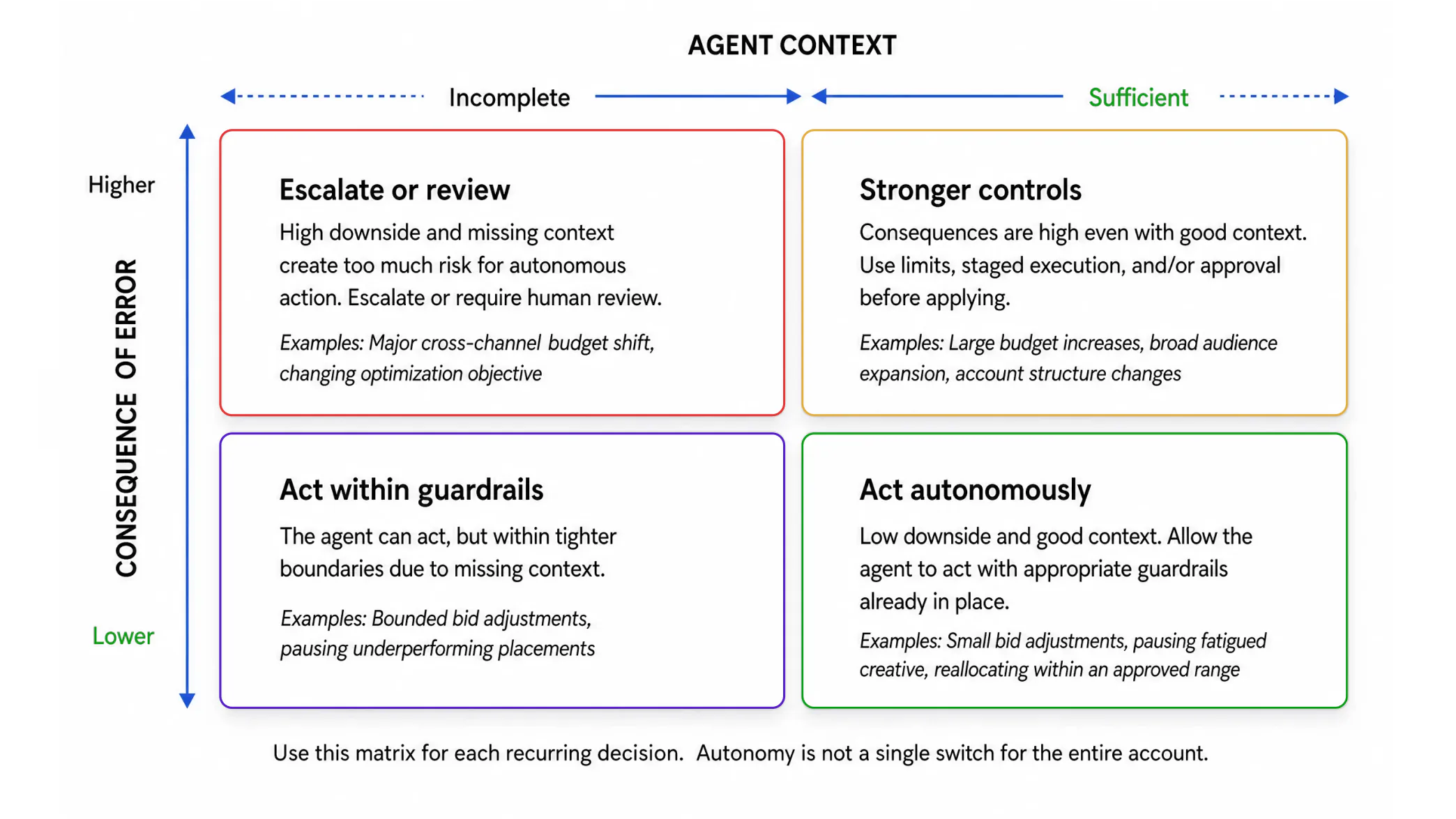
Too much autonomy
Giving an agent unrestricted authority over every decision creates an obvious risk. It will eventually respond to a weak signal, incomplete context, or an unusual account condition. If the decision is consequential, the cost can accumulate before anyone notices.
Speed only helps when the system is operating inside a boundary the team is comfortable with.
Too little autonomy
The opposite setup has a quieter cost. If every routine adjustment requires a person to approve it, the team has not handed off much work. It has added an approval step to a process someone was already running.
Different decisions need different levels of authority. A useful control model should make that boundary explicit rather than forcing the whole account into one setting.
Use consequence and context to set the boundary
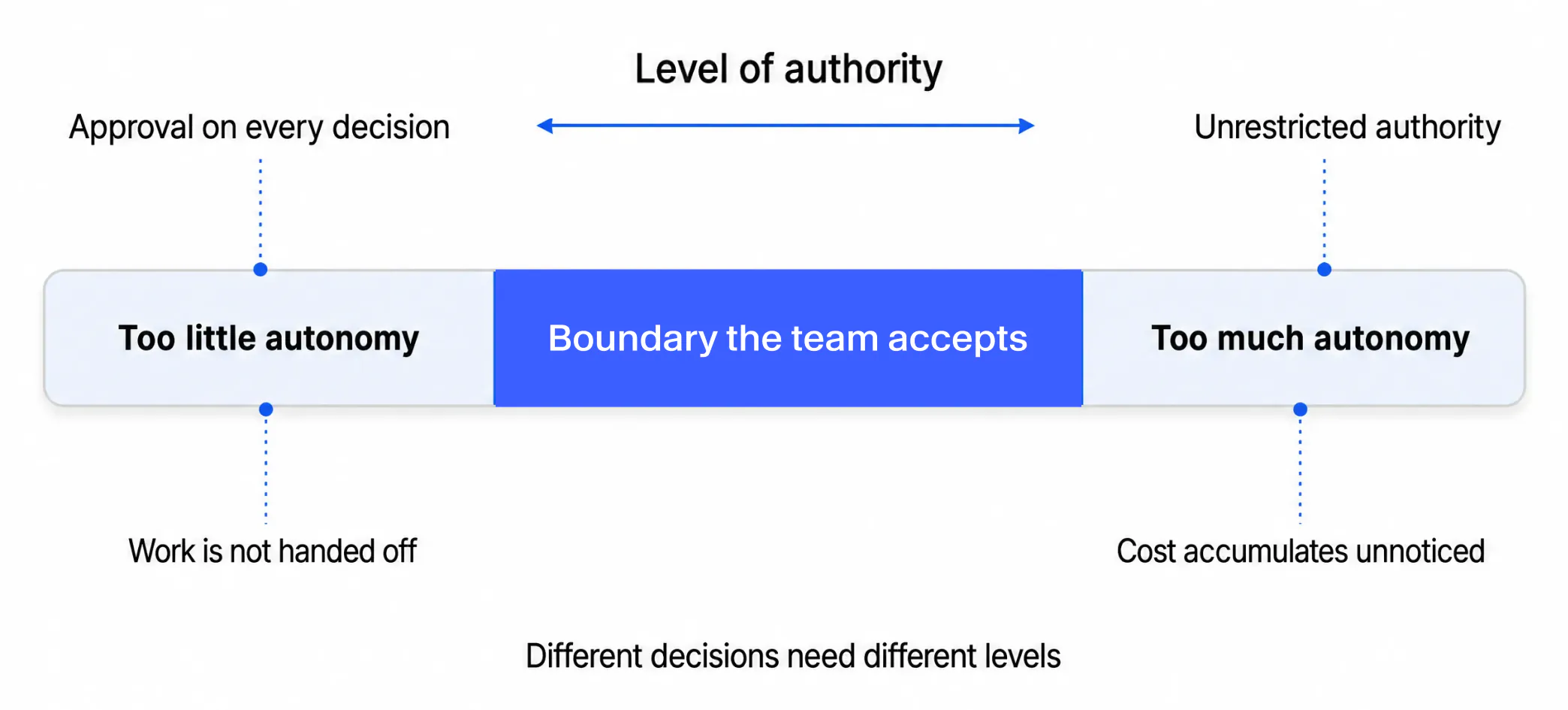
For every recurring decision, ask two questions:
- How consequential is it if the agent gets the decision wrong?
- Does the agent have the context required to make the decision well?
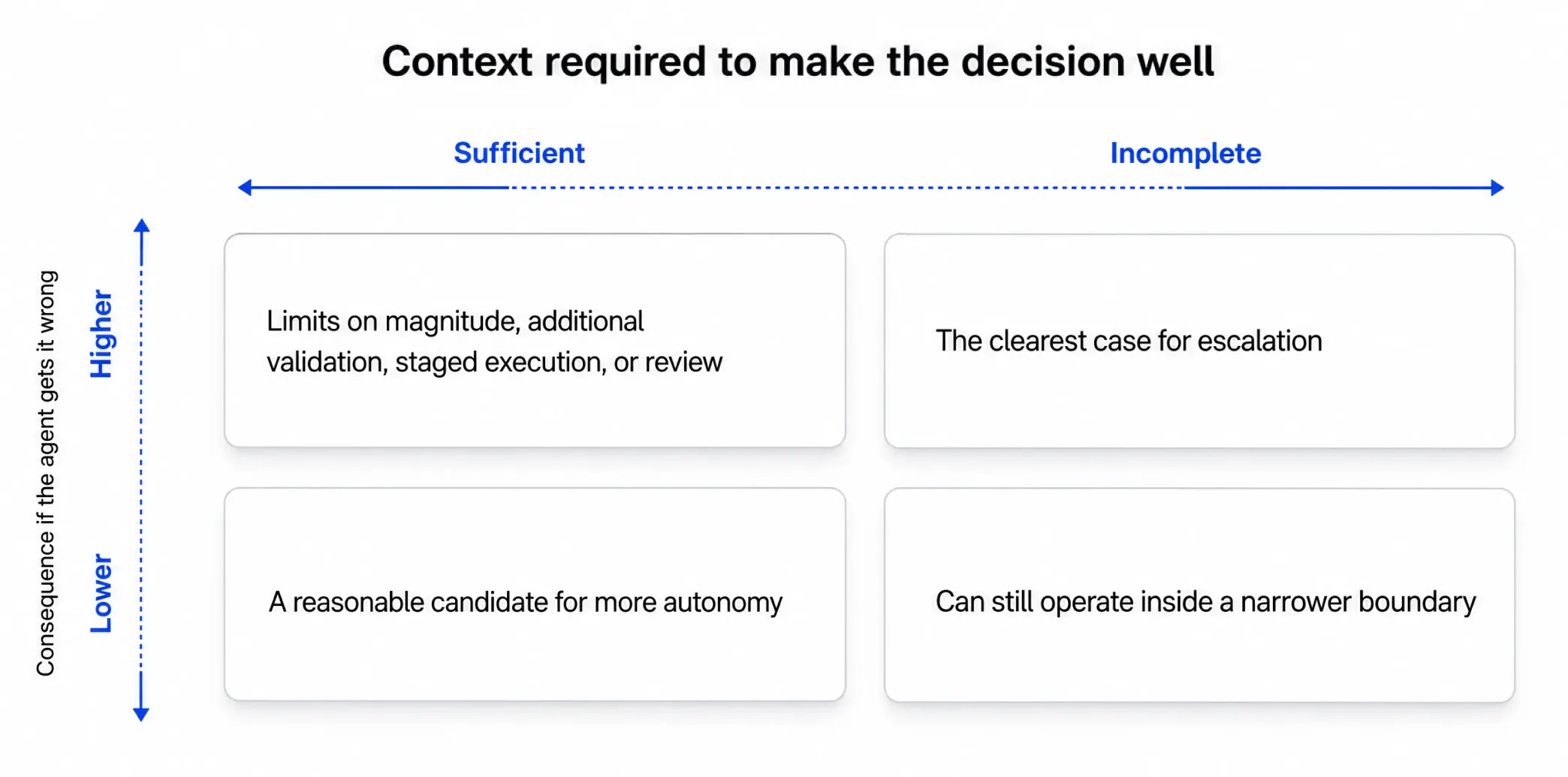
A lower-consequence decision based on context already available to the agent is a reasonable candidate for more autonomy. As the potential downside rises, or the necessary context becomes less complete, tighter limits, validation, or human review become more valuable.
Lower consequence, sufficient context
A small bid or budget adjustment inside an approved range can have limited downside when the relevant account context is available. Requiring approval for every instance may add friction without adding much judgment.
Lower consequence, incomplete context
The agent can still operate inside a narrower boundary. For example, it might make a bounded adjustment while avoiding a decision that depends on an upcoming promotion, inventory change, or other business condition it cannot see.
Higher consequence, sufficient context
Good context does not make a consequential action low-risk. A large change can still warrant limits on magnitude, additional validation, staged execution, or review because the cost of a mistake is high.
Higher consequence, incomplete context
This is the clearest case for escalation. A major cross-channel budget shift or a change to the account's optimization objective may depend on business information the system does not have. Acting anyway turns missing context into operating risk.
A reversible action can still be expensive
A decision is not low-risk simply because the platform lets you change it back. What matters is what can happen between the action and the correction.
Evaluate consequence across three dimensions:
- Exposure: how much spend, volume, or business impact is at risk?
- Velocity: how quickly could the downside accumulate before detection?
- Recoverability: how much of the action and its effects can actually be reversed?
A large budget increase may be technically reversible, but the spend incurred before reversal is not. The same logic applies to a campaign pause during a short promotion window or a change that disrupts a high-volume program. Reversibility is useful; it is not a substitute for setting the right boundary in the first place.
Auditability is part of the control system
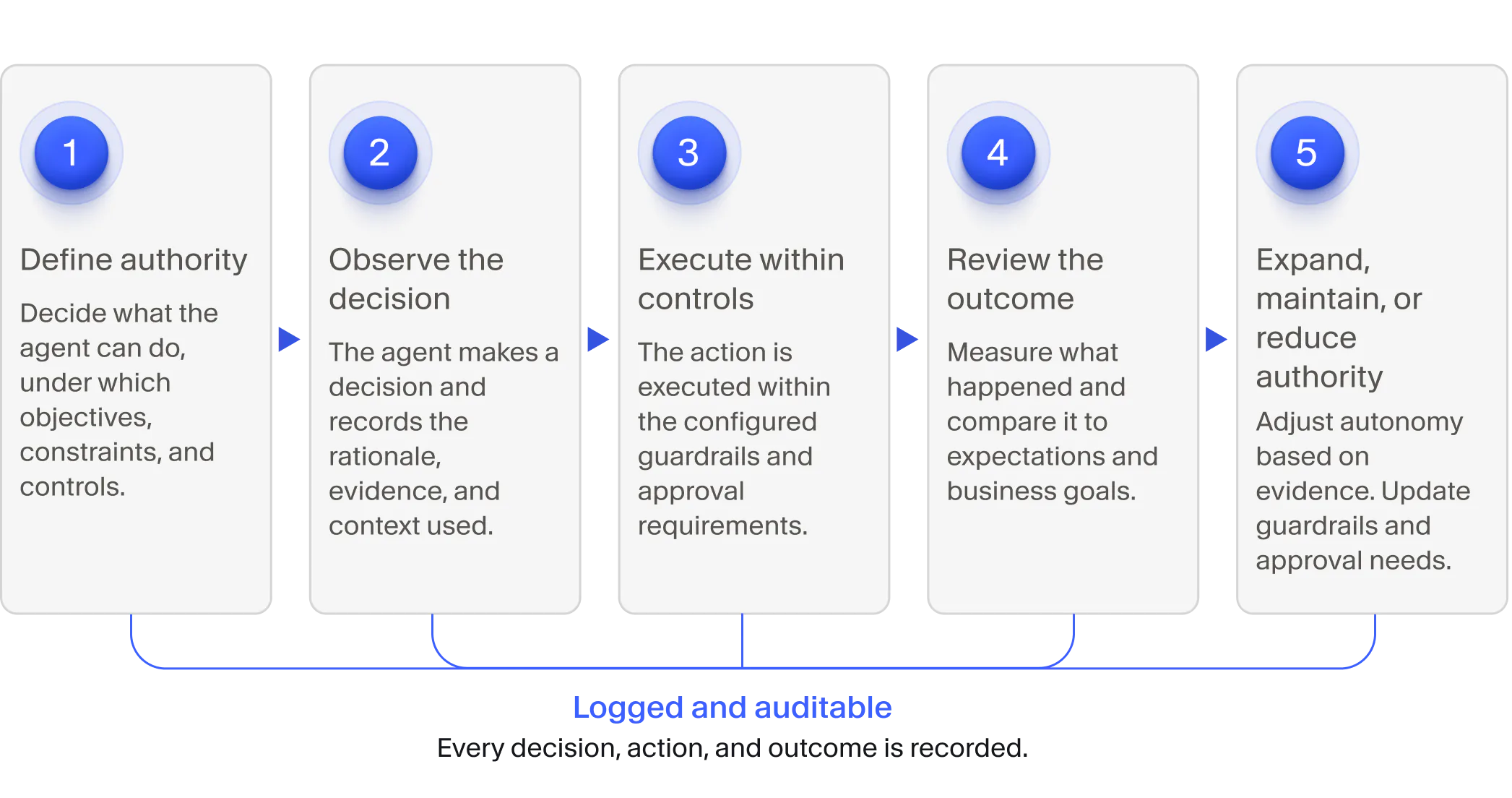
Whatever authority an agent receives, the team should be able to inspect what changed, why it changed, which controls applied, and what happened next.
That record makes the current decision accountable. It also gives the team evidence for deciding whether the agent should receive more or less authority over time.
When evaluating a vendor, ask to see a real decision trail:
- What decision did the system make?
- What evidence and business context did it use?
- Which guardrails or approvals applied?
- What action occurred?
- What happened afterward?
If that sequence is a black box, the team cannot tell whether the autonomy is working or whether the boundary should change.
The autonomy feedback loop
Autonomy should expand or contract based on evidence, not vendor promises.
Three control modes for the account
The exact names will vary by product, but the operating pattern is straightforward. Routine work can execute inside established limits. Higher-impact actions can wait for confirmation. Decisions that exceed the system's authority or available context should stop and escalate.
- Operate: execute routine, lower-consequence decisions inside configured objectives, constraints, and controls.
- Confirm: prepare a higher-impact action for review before execution.
- Escalate: stop and request missing business context or human judgment when the decision exceeds the current boundary.
This gives the team a practical way to delegate recurring work without pretending every media decision deserves the same amount of autonomy.
How MAI approaches autonomy
MAI is designed to operate within configured objectives, constraints, and execution controls. Its workflows can support reviewable proposals, pause and resume behavior, changelogs, external-change detection, and manual or scheduled execution depending on configuration. The team still sets the goals and determines where review is required.
That matters when the system does not have enough context. If a decision depends on information that is missing, the right response is a narrower guardrail or review—not an assumption that the agent somehow knows the answer.
The same principle applies to cross-channel decisions. MAI can support cross-channel allocation recommendations and scenario planning. Any path from recommendation to execution depends on the workflow, permissions, and current configuration.
For the broader distinction between recommendation software and an agent that can carry work through to action, see what an AI performance marketing agent actually does.
Set the boundary you can defend
A useful autonomy model should let the team answer three questions for any recurring decision: what the agent is allowed to do, what evidence and context it needs before acting, and when the decision has to come back to a person.
Then the team needs a record of what happened so that authority can expand, stay where it is, or contract based on evidence rather than comfort level.